---
title: Comparing The Most Common Materials in HVAC Insulation Applications (Fiberglass vs. Foam vs. Non-Wovens)
description: The HVAC industry covers many applications and products with a small number of materials. Learn more about them from the experts at Mueller.
image: https://blog.cohesivecomponents.com/hubfs/unnamed%20(20).jpg
---
[](https://www.sur-seal.com/)
[704.837.8139](tel:+7048378139)
[GET A CUSTOM QUOTE](https://www.sur-seal.com/request-a-quote/)
- [Markets](https://www.sur-seal.com/markets/)
- [Aerospace Solutions](https://www.sur-seal.com/markets/aerospace/)
- [Alternative Energy Solutions](https://www.sur-seal.com/markets/ev-alternative-energy/)
- [Climate Control Solutions](https://www.sur-seal.com/markets/climate-control/)
- [Electrical Sealing Solutions](https://www.sur-seal.com/markets/lighting/)
- [Healthcare Solutions](https://www.sur-seal.com/markets/medical-healthcare/)
- [Industrial Solutions](https://www.sur-seal.com/markets/industrial/)
- [Solar Solutions](https://www.sur-seal.com/markets/solar/)
- [Capabilities](https://www.sur-seal.com/services/)
- [CNC Cutting](https://www.sur-seal.com/services/cnc-cutting/)
- [Custom Assembly](https://www.sur-seal.com/services/custom-assembly/)
- [Die Cutting](https://www.sur-seal.com/services/die-cutting/)
- [Rapid Prototyping](https://www.sur-seal.com/services/die-cut-prototyping/)
- [Engineering](https://www.sur-seal.com/services/engineering/)
- [Laminating](https://www.sur-seal.com/services/laminating/)
- [Laser and Optical Inspection](https://www.sur-seal.com/services/laser-inspection/)
- [Precision Slitting](https://www.sur-seal.com/services/precision-slitting/)
- [Design Collaboration](https://www.sur-seal.com/services/product-collaboration/)
- [Product Manufacturing](https://www.sur-seal.com/services/product-manufacturing/)
- [Sealing & Containment](https://www.sur-seal.com/services/sealing-containment/)
- [Tubing](https://www.sur-seal.com/services/tubing/)
- [Extrusion](https://www.sur-seal.com/services/extrusion/)
- [Water Jet Cutting](https://www.sur-seal.com/services/water-jet-cutting/)
- [Precision Skiving](https://www.sur-seal.com/services/precision-skiving/)
- [Sheeting](https://www.sur-seal.com/services/sheeting/)
- [Molding](https://www.sur-seal.com/services/molding/)
- [Materials](https://www.sur-seal.com/products/)
- [Acoustic Insulation](https://www.sur-seal.com/products/acoustic-insulation/)
- [Custom Gaskets](https://www.sur-seal.com/products/gaskets/)
- [Environmental Seals](https://www.sur-seal.com/products/environment-seals/)
- [Filtration](https://www.sur-seal.com/products/filtration/)
- [Foams](https://www.sur-seal.com/products/foam/)
- [Plastics](https://www.sur-seal.com/products/plastic/)
- [Silicones](https://www.sur-seal.com/products/silicone/)
- [Rubber](https://www.sur-seal.com/products/rubber/)
- [Tapes & Adhesives](https://www.sur-seal.com/products/tapes-adhesives/)
- [Thermal Management](https://www.sur-seal.com/products/thermal-management/)
- [Nonwovens](https://www.sur-seal.com/products/nonwovens/)
- [Paper, Films & Foils](https://www.sur-seal.com/products/papers-films-foils/)
- [Reclosable Fasteners](https://www.sur-seal.com/products/reclosable-fasteners/)
- [About](https://www.sur-seal.com/about/)
- [Careers](https://www.sur-seal.com/careers/)
- [Case Studies](https://www.sur-seal.com/case-studies/)
- [Locations](https://www.sur-seal.com/locations/)
- [News](https://www.sur-seal.com/blog/news/)
- [Service Area](https://www.sur-seal.com/service-area/)
- [Testimonials](https://www.sur-seal.com/reviews/)
- [Quality](https://www.sur-seal.com/about/quality/)
- [Blog](https://www.sur-seal.com/blog/)
[Contact Us](https://www.sur-seal.com/contact/)
[](https://www.sur-seal.com/)
[tel:+18887310765](tel:+18887310765)
[](https://www.sur-seal.com/)
- [Markets](https://www.sur-seal.com/markets/)
- [Markets](https://www.sur-seal.com/markets/)
- [Aerospace Solutions](https://www.sur-seal.com/markets/aerospace/)
- [Alternative Energy Solutions](https://www.sur-seal.com/markets/ev-alternative-energy/)
- [Climate Control Solutions](https://www.sur-seal.com/markets/climate-control/)
- [Electrical Sealing Solutions](https://www.sur-seal.com/markets/lighting/)
- [Healthcare Solutions](https://www.sur-seal.com/markets/medical-healthcare/)
- [Industrial Solutions](https://www.sur-seal.com/markets/industrial/)
- [Solar Solutions](https://www.sur-seal.com/markets/solar/)
- [Capabilities](https://www.sur-seal.com/services/)
- [Capabilities](https://www.sur-seal.com/services/)
- [CNC Cutting](https://www.sur-seal.com/services/cnc-cutting/)
- [Custom Assembly](https://www.sur-seal.com/services/custom-assembly/)
- [Die Cutting](https://www.sur-seal.com/services/die-cutting/)
- [Rapid Prototyping](https://www.sur-seal.com/services/die-cut-prototyping/)
- [Engineering](https://www.sur-seal.com/services/engineering/)
- [Laminating](https://www.sur-seal.com/services/laminating/)
- [Laser and Optical Inspection](https://www.sur-seal.com/services/laser-inspection/)
- [Precision Slitting](https://www.sur-seal.com/services/precision-slitting/)
- [Design Collaboration](https://www.sur-seal.com/services/product-collaboration/)
- [Product Manufacturing](https://www.sur-seal.com/services/product-manufacturing/)
- [Sealing & Containment](https://www.sur-seal.com/services/sealing-containment/)
- [Tubing](https://www.sur-seal.com/services/tubing/)
- [Extrusion](https://www.sur-seal.com/services/extrusion/)
- [Water Jet Cutting](https://www.sur-seal.com/services/water-jet-cutting/)
- [Precision Skiving](https://www.sur-seal.com/services/precision-skiving/)
- [Sheeting](https://www.sur-seal.com/services/sheeting/)
- [Molding](https://www.sur-seal.com/services/molding/)
- [Materials](https://www.sur-seal.com/products/)
- [Materials](https://www.sur-seal.com/products/)
- [Acoustic Insulation](https://www.sur-seal.com/products/acoustic-insulation/)
- [Custom Gaskets](https://www.sur-seal.com/products/gaskets/)
- [Environmental Seals](https://www.sur-seal.com/products/environment-seals/)
- [Filtration](https://www.sur-seal.com/products/filtration/)
- [Foams](https://www.sur-seal.com/products/foam/)
- [Plastics](https://www.sur-seal.com/products/plastic/)
- [Silicones](https://www.sur-seal.com/products/silicone/)
- [Rubber](https://www.sur-seal.com/products/rubber/)
- [Tapes & Adhesives](https://www.sur-seal.com/products/tapes-adhesives/)
- [Thermal Management](https://www.sur-seal.com/products/thermal-management/)
- [Nonwovens](https://www.sur-seal.com/products/nonwovens/)
- [Paper, Films & Foils](https://www.sur-seal.com/products/papers-films-foils/)
- [Reclosable Fasteners](https://www.sur-seal.com/products/reclosable-fasteners/)
- [About](https://www.sur-seal.com/about/)
- [About](https://www.sur-seal.com/about/)
- [Careers](https://www.sur-seal.com/careers/)
- [Case Studies](https://www.sur-seal.com/case-studies/)
- [Locations](https://www.sur-seal.com/locations/)
- [News](https://www.sur-seal.com/blog/news/)
- [Service Area](https://www.sur-seal.com/service-area/)
- [Testimonials](https://www.sur-seal.com/reviews/)
- [Quality](https://www.sur-seal.com/about/quality/)
- [Blog](https://www.sur-seal.com/blog/)
- [Contact Us](https://www.sur-seal.com/contact/)
Mueller Blog
# Comparing The Most Common Materials in HVAC Insulation Applications (Fiberglass vs. Foam vs. Non-Wovens)
Posted by [Mueller Custom Cut Solutions Team](https://blog.cohesivecomponents.com/author/mueller-custom-cut-solutions-team) on Dec 27, 2019, 10:46:56 AM
- [Tweet](https://twitter.com/share)
.jpg?width=511&name=unnamed%20(20).jpg)
The [HVAC market](https://muellercustomcut.com/HVAC) has been around for some time, which means that certain materials are recognized as the best of the best. Among the most common materials are fiberglass and foams, including [crushed, open-cell, and closed-cell](https://blog.muellercustomcut.com/electronics/open-cell-closed-cell-foam-gasket) varieties.
[](https://cta-redirect.hubspot.com/cta/redirect/6466240/8543cca9-f3de-4876-ac04-ed67f728b2d2)
Currently, non-woven materials are trying to find their way into an industry that is dominated by a small number of materials.
In this guide, the HVAC experts at Mueller will take you through the properties and uses of fiberglass, foams, and potential uses for non-woven materials (as well as tips for choosing the right part for any application). You’ll then be able to better understand the market you serve, and maybe even find some new uses for materials that you’re familiar with.
## Why is Fiberglass Used for in HVAC Applications?
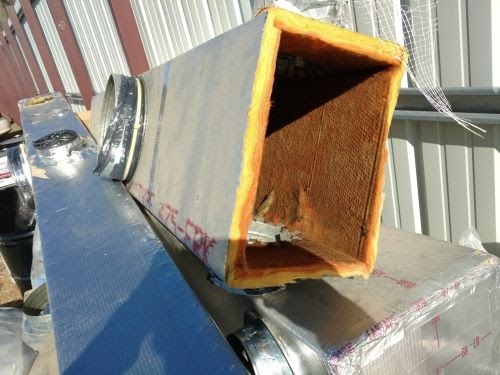
Fiberglass is one of the most inexpensive and versatile materials in the HVAC industry, and it also has both thermal and acoustic insulating properties.
Fiberglass can be used in HVAC applications with a foil facing, which contains fiberglass loose fibers and prevents them from getting into airflows while also enhancing insulating properties. Fiberglass with a foil facing can also provide acoustical enhancements, as facings work to suppress noises. Micro-perforating the facing will further enhance its acoustic capabilities.
Fiberglass has many uses in the HVAC industry, ranging from unit to home insulation. It can also be used in [ductwork](https://www.homeselfe.com/the-types-of-ducts-in-a-home/), taking the place of sheet metal. These fiberglass ducts look and function like standard metal ducts, but at a lower cost with built-in insulation. There is a downside to using fiberglass such as airborne fibers and for some people it can be a skin irritant.
## How is Foam Used in HVAC Applications?
There are three types of foam that are prominently used in HVAC applications: **crushed,** [**closed-cell, and open-cell foam**](https://tigerfoam.com/sprayfoaminsulation/open-cell-vs-closed-cell-foam-which-should-i-choose/). Each type serves a different purpose and offers a unique insulation property.
### Crushed Foam
Crushed foam is primarily used as a gap-filler in HVAC units. All units have different metal gauges that affect their sturdiness, and a recent industry trend has been to lower gauges as far as they can go without having structural issues as a way of cutting costs. Crushed foam is used in these applications because it fills gaps in surfaces that are inconsistent, and does so without causing deflection in thin metals or plastics.
### Closed-Cell Foam
Closed-cell foams, such as Poron and silicone, are higher-end materials that take on a lower compression set than other closed cell foams. This foam type is used in multiple applications, but mainly in unit access doors. Closed-cell foams prevent against leaks and moisture issues, as well as offering a degree of noise insulation. This material type is also used around electrical enclosures.
### Open-Cell Foam
Lastly, open-cell foams are used as either [environmental filters](https://blog.muellercustomcut.com/electronics/environmental-interference-material) or acoustic buffers. If the foam has reticulated open pores, it allows air to pass through while catching debris or other harmful materials. This foam type, specifically polyurethane ester and ether, can also be placed between a unit’s metal components to reduce vibration and provide acoustic insulation.
## Where Will Non-Woven Materials Be Used in HVAC Applications?
There are very few non-woven materials currently being used in the HVAC industry. However, this doesn’t mean the potential for them to be used is not there.
Many companies that produce [non-wovens](https://blog.muellercustomcut.com/comparing-thermoacoustic-foam-non-woven-material) are trying to break into the HVAC market. For the most part, their products are just now receiving UL testing approvals, so they can be cleared for use. Non-woven materials have the potential to be excellent thermal and acoustic insulators and are much cleaner non-irritant materials.
.jpg?width=511&name=unnamed%20(21).jpg)
## How Do You Choose the Right Insulating Material?
Choosing the right material for your application comes down to two factors: knowing what the product will do and the specifications it must meet.
If you need a material to work in a loud or high-temperature environment, look into ordering a thicker part. The thicker the material is, the greater its thermal and acoustic insulation properties, which applies to both fiberglass and foams.
The [density of an insulation material](https://www.isover.co.uk/news/insulation-density-and-thermal-conductivity) will also affect performance and contribute to your selection process. It’s important to note that a material’s density is a “trickle-down scale,” which means that increases in density are not linear. This has to do with the material’s air pockets and finding the right size for ideal thermal and acoustic insulation. If a material’s density increases, it will eventually reach maximum density, and there will be nothing left to compress, altering the insulation ability of the material.
For specifications, HVAC materials are heavily driven by UL flammability ratings. Residential, commercial, rooftop, and interior unit types all have different ratings that the materials need to meet. According to UL standards, there is a certain percentage of materials that need to be UL-rated based on the unit’s size. Understanding both the standards you need to meet (and the percentage of materials that you need to meet them) is crucial for creating a great product.
## Why Does Understanding These Different Materials Matter?
The HVAC industry covers a wide variety of applications and products but features a small number of materials. By gaining a greater understanding of those materials, such as fiberglass, foams, and non-wovens, you can be more knowledgeable about the market and clients you serve.
Learning the properties and functions of materials (such as fiberglass, crushed foam, open-cell foam, and closed-cell foam), as well as how they relate to one another, is crucial for crafting the best HVAC products possible. Likewise, knowing how to choose not only the right material, but the right material thickness, density, and standards, will lead to better units.
Combine the key factors discussed in this guide with your own industry expertise to make the right material decision for any customer application.
## [](https://cta-redirect.hubspot.com/cta/redirect/6466240/79815f67-1082-47cd-aab1-224837af7a83)
Topics: [Foam](https://blog.cohesivecomponents.com/tag/foam), [HVAC](https://blog.cohesivecomponents.com/tag/hvac)
### Industries Served
- [Aerospace](https://muellercustomcut.com/aerospace/)
- [Meters](https://muellercustomcut.com/application/)
- [Electronics](https://muellercustomcut.com/electronics/)
- [Automotive](https://muellercustomcut.com/application/)
- [Health & Safety](https://muellercustomcut.com/application/)
- [Lighting](https://muellercustomcut.com/electronics/)
- [Power Gen](https://muellercustomcut.com/application/)
### Fill out the form below for assistance from our experts!
Video Gallery
[Watch More](https://muellercustomcut.com/videos/)
Case Studies

Supply Chain Reaction - Auto Gaskets
[DOWNLOAD HERE >](https://4p7hxp742jrqk2r2g049wf-wpengine.netdna-ssl.com/wp-content/uploads/2019/06/Auto-Case-Study.pdf)

A Value-Add Proposition - HVAC Gaskets
[DOWNLOAD HERE >](https://4p7hxp742jrqk2r2g049wf-wpengine.netdna-ssl.com/wp-content/uploads/2019/06/HVAC-Case-Study.pdf)
[](https://sur-seal.com)
[](https://sur-seal.com)
[Contact Us](https://blog.cohesivecomponents.com/sur-seal.com/contact/)
[704.837.8139](tel:+7048378139)
- SERVICES
- [Custom Gaskets](https://www.sur-seal.com/products/gaskets/)
- [CNC Cutting](https://www.sur-seal.com/services/cnc-cutting/)
- [Sealing & Containment](https://www.sur-seal.com/services/sealing-containment/)
- [Die Cutting](https://www.sur-seal.com/services/die-cutting/)
- [Product Manufacturing](https://www.sur-seal.com/services/product-manufacturing/)
- About
- [About](https://www.sur-seal.com/about/)
- [Markets](https://www.sur-seal.com/markets/)
- [Blog](https://www.sur-seal.com/blog/)
- [Careers](https://www.sur-seal.com/careers/)
- [Service Area](https://www.sur-seal.com/service-area/)
Service Areas
- [Alabama](https://www.sur-seal.com/service-area/alabama/)
- [Arizona](https://www.sur-seal.com/service-area/arizona/)
- [Arkansas](https://www.sur-seal.com/service-area/arkansas/)
- [California](https://www.sur-seal.com/service-area/california/)
- [Colorado](https://www.sur-seal.com/service-area/colorado/)
- [Connecticut](https://www.sur-seal.com/service-area/connecticut/)
- [Delaware](https://www.sur-seal.com/service-area/delaware/)
- [Florida](https://www.sur-seal.com/service-area/florida/)
- [Georgia](https://www.sur-seal.com/service-area/georgia/)
- [Idaho](https://www.sur-seal.com/service-area/idaho/)
- [Illinois](https://www.sur-seal.com/service-area/illinois/)
- [Indiana](https://www.sur-seal.com/service-area/indiana/)
- [Iowa](https://www.sur-seal.com/service-area/iowa/)
- [Kansas](https://www.sur-seal.com/service-area/kansas/)
- [Kentucky](https://www.sur-seal.com/service-area/kentucky/)
- [Louisiana](https://www.sur-seal.com/service-area/louisiana/)
- [Maine](https://www.sur-seal.com/service-area/maine/)
- [Maryland](https://www.sur-seal.com/service-area/maryland/)
- [Massachusetts](https://www.sur-seal.com/service-area/massachusetts)
- [Michigan](https://www.sur-seal.com/service-area/michigan/)
- [Minnesota](https://www.sur-seal.com/service-area/minnesota/)
- [Mississippi](https://www.sur-seal.com/service-area/mississippi/)
- [Missouri](https://www.sur-seal.com/service-area/missouri/)
- [Montana](https://www.sur-seal.com/service-area/montana/)
- [Nebraska](https://www.sur-seal.com/service-area/nebraska/)
- [Nevada](https://www.sur-seal.com/service-area/nevada/)
- [New Hampshire](https://www.sur-seal.com/service-area/new-hampshire/)
- [New Jersey](https://www.sur-seal.com/service-area/new-jersey/)
- [New Mexico](https://www.sur-seal.com/service-area/new-mexico/)
- [New York](https://www.sur-seal.com/service-area/new-york/)
- [North Carolina](https://www.sur-seal.com/service-area/north-carolina/)
- [North Dakota](https://www.sur-seal.com/service-area/north-dakota/)
- [Ohio](https://www.sur-seal.com/service-area/ohio/)
- [Oklahoma](https://www.sur-seal.com/service-area/oklahoma/)
- [Oregon](https://www.sur-seal.com/service-area/oregon/)
- [Pennsylvania](https://www.sur-seal.com/service-area/pennsylvania/)
- [Rhode Island](https://www.sur-seal.com/service-area/rhode-island/)
- [South Carolina](https://www.sur-seal.com/service-area/south-carolina/)
- [South Dakota](https://www.sur-seal.com/service-area/south-dakota/)
- [Tennessee](https://www.sur-seal.com/service-area/tennessee/)
- [Texas](https://www.sur-seal.com/service-area/texas/)
- [Utah](https://www.sur-seal.com/service-area/utah/)
- [Vermont](https://www.sur-seal.com/service-area/vermont/)
- [Virginia](https://www.sur-seal.com/service-area/virginia/)
- [Washington](https://www.sur-seal.com/service-area/washington/)
- [Washington, DC](https://www.sur-seal.com/service-area/washington-dc/)
- [West Virginia](https://www.sur-seal.com/service-area/west-virginia/)
- [Wisconsin](https://www.sur-seal.com/service-area/wisconsin/)
- [Wyoming](https://www.sur-seal.com/service-area/wyoming/)
© 2026 SUR-SEAL | Web Design by [ Blue Corona](https://www.bluecorona.com/) | [Privacy Policy](https://www.sur-seal.com/privacy-policy/) | Disclaimer
[ Contact Us](https://www.sur-seal.com/?hsCacheBuster=4487#)
```json
{
"@context" : "http://schema.org",
"@type" : "Article",
"articleBody" : "The HVAC market has been around for some time, which means that certain materials are recognized as the best of the best. Among the most common materials are fiberglass and foams, including crushed, open-cell, and closed-cell varieties. \nSchedule a Time to Speak With an Expert
\nCurrently, non-woven materials are trying to find their way into an industry that is dominated by a small number of materials.
\nIn this guide, the HVAC experts at Mueller will take you through the properties and uses of fiberglass, foams, and potential uses for non-woven materials (as well as tips for choosing the right part for any application). You’ll then be able to better understand the market you serve, and maybe even find some new uses for materials that you’re familiar with.
\nWhy is Fiberglass Used for in HVAC Applications?
\nFiberglass is one of the most inexpensive and versatile materials in the HVAC industry, and it also has both thermal and acoustic insulating properties.
\nFiberglass can be used in HVAC applications with a foil facing, which contains fiberglass loose fibers and prevents them from getting into airflows while also enhancing insulating properties. Fiberglass with a foil facing can also provide acoustical enhancements, as facings work to suppress noises. Micro-perforating the facing will further enhance its acoustic capabilities.
\nFiberglass has many uses in the HVAC industry, ranging from unit to home insulation. It can also be used in ductwork, taking the place of sheet metal. These fiberglass ducts look and function like standard metal ducts, but at a lower cost with built-in insulation. There is a downside to using fiberglass such as airborne fibers and for some people it can be a skin irritant.
\n
\nHow is Foam Used in HVAC Applications?
\nThere are three types of foam that are prominently used in HVAC applications: crushed, closed-cell, and open-cell foam. Each type serves a different purpose and offers a unique insulation property.
\nCrushed Foam
\nCrushed foam is primarily used as a gap-filler in HVAC units. All units have different metal gauges that affect their sturdiness, and a recent industry trend has been to lower gauges as far as they can go without having structural issues as a way of cutting costs. Crushed foam is used in these applications because it fills gaps in surfaces that are inconsistent, and does so without causing deflection in thin metals or plastics.
\nClosed-Cell Foam
\nClosed-cell foams, such as Poron and silicone, are higher-end materials that take on a lower compression set than other closed cell foams. This foam type is used in multiple applications, but mainly in unit access doors. Closed-cell foams prevent against leaks and moisture issues, as well as offering a degree of noise insulation. This material type is also used around electrical enclosures.
\nOpen-Cell Foam
\nLastly, open-cell foams are used as either environmental filters or acoustic buffers. If the foam has reticulated open pores, it allows air to pass through while catching debris or other harmful materials. This foam type, specifically polyurethane ester and ether, can also be placed between a unit’s metal components to reduce vibration and provide acoustic insulation.
\nWhere Will Non-Woven Materials Be Used in HVAC Applications?
\nThere are very few non-woven materials currently being used in the HVAC industry. However, this doesn’t mean the potential for them to be used is not there.
\nMany companies that produce non-wovens are trying to break into the HVAC market. For the most part, their products are just now receiving UL testing approvals, so they can be cleared for use. Non-woven materials have the potential to be excellent thermal and acoustic insulators and are much cleaner non-irritant materials.
\n.jpg?width=511&name=unnamed%20(21).jpg\")
\nHow Do You Choose the Right Insulating Material?
\nChoosing the right material for your application comes down to two factors: knowing what the product will do and the specifications it must meet.
\nIf you need a material to work in a loud or high-temperature environment, look into ordering a thicker part. The thicker the material is, the greater its thermal and acoustic insulation properties, which applies to both fiberglass and foams.
\nThe density of an insulation material will also affect performance and contribute to your selection process. It’s important to note that a material’s density is a “trickle-down scale,” which means that increases in density are not linear. This has to do with the material’s air pockets and finding the right size for ideal thermal and acoustic insulation. If a material’s density increases, it will eventually reach maximum density, and there will be nothing left to compress, altering the insulation ability of the material.
\nFor specifications, HVAC materials are heavily driven by UL flammability ratings. Residential, commercial, rooftop, and interior unit types all have different ratings that the materials need to meet. According to UL standards, there is a certain percentage of materials that need to be UL-rated based on the unit’s size. Understanding both the standards you need to meet (and the percentage of materials that you need to meet them) is crucial for creating a great product.
\nWhy Does Understanding These Different Materials Matter?
\nThe HVAC industry covers a wide variety of applications and products but features a small number of materials. By gaining a greater understanding of those materials, such as fiberglass, foams, and non-wovens, you can be more knowledgeable about the market and clients you serve.
\nLearning the properties and functions of materials (such as fiberglass, crushed foam, open-cell foam, and closed-cell foam), as well as how they relate to one another, is crucial for crafting the best HVAC products possible. Likewise, knowing how to choose not only the right material, but the right material thickness, density, and standards, will lead to better units.
\nCombine the key factors discussed in this guide with your own industry expertise to make the right material decision for any customer application.",
"articleSection" : "Foam, HVAC",
"author" : {
"@type" : "Person",
"name" : "Mueller Custom Cut Solutions Team"
},
"datePublished" : "2019-12-27T10:46:56",
"image" : "https://blog.muellercustomcut.com/hs-fs/hubfs/unnamed%20(20).jpg?width=511&name=unnamed%20(20).jpg",
"name" : "Comparing The Most Common Materials in HVAC Insulation Applications (Fiberglass vs. Foam vs. Non-Wovens)",
"publisher" : {
"@type" : "Organization",
"name" : "Mueller Custom Cut"
},
"url" : "https://blog.muellercustomcut.com/comparing-most-common-insulating-materials"
}
```